In the distance, the Washington monument sliced into the grey nor’easter horizon. From my vantage point, that granite obelisk was but a small horned accessory to an empty SECU Stadium on the campus of the University of Maryland on a college football Saturday. Be it because of defensive, social, or even barometric pressure, the arena was shamefully barren.
I’ll do my best to avoid this blurb festering into a digressionary think piece, which at times will be hard. Especially with a crystal clear view of the nation’s capital from my twenty-five dollar bleacher seats that were closer to the altitude of that pyramidal monument topper roughly eight miles to the southeast than the football field. So for a moment let’s zoom in.
A bad college football team lost a home game. Badly. In front of a crowd that could be rivaled by the audience of a church picnic softball game. Their head coach is in his eighth year. The team was 4-8 in each of the last two seasons under his tutelage and a combined 2-16 in Big Ten play over the last two seasons. They’ve had a winning record just twice in the regular season during his tenure, both times finishing 7-5. It’s easy to say watching these Terrapins play football might not be enjoyable, even to the most ravenous alumni and students who dub themselves football fans.
Now zoom out a smidge. The university is an R1 doctoral university, signifying an elite institution and “very high research activity.” According to the National Science Foundation, the university spent a combined $1.14 billion on research and development in 2021, ranking it 17th among American universities. It’s also dubbed a “Public Ivy.” Ivy League schools don’t care about football. Certainly not to the extent that the division one elite are required to in order to be nationally relevant. Perhaps this desolate atmosphere can be attributed to the fact that there is schoolwork to be done, and what better time to study than on a dreary Saturday afternoon in early fall?
Zoom out further, and there is an arms race occurring in college sports. In July 2021, the NCAA allowed college athletes to profit from their name, image, and likeness. This is the first time in the organization’s century-long history where athletes are getting paid. Four years later in July 2025, revenue sharing was green-lit, allowing players to be paid directly for their performances. (Though in that four year span, players were already being paid by boosters and other financial sources for their play, repackaged and disguised as NIL deals). There had been immense pushback from college football fans to pay for play. Fear that the beloved game would be commodified, that the passion would dissipate, and school pride could be bought were all featured grievances. I feel I witnessed these qualms rear their ugly heads truly for the first time in College Park, Maryland.
An overpriced nosebleed seat can be dismissed as a moot point perhaps if the stadium was full, but leisure is often not willingly sacrificed by college goers to the point of any neutral observer noticing. Commodification of the product on the field has unleashed the same effect on the entire game day experience. Before this season, season ticket prices at UMD hiked higher than ever before. Some of the most long-term season ticket holders were priced out of their sections or simply moved to worse seats against their wishes in favor of higher-paying patrons. It has been made quite obvious that fans are refusing to accept this half-baked experience and simply choose to spend their Saturdays elsewhere. Who can blame a student for watching the game with their roommates in their apartment when they can simply flip the channel to a different game when their beloved Terps throw their fourth interception of the contest? Why would alumni bother to pay to park and buy a ticket in the lower bowl (most of which were priced at over 100$) when the school refuses to fire their inept head coach because they can’t afford his buyout?
Everything on this game day was an advertisement. By the late third quarter, cheerleaders were throwing t-shirts to a student section made up of 25 kids under 15 years old. T-shirts which by the way had an enormous company logo on them that was completely unrelated to the team they were there to support.
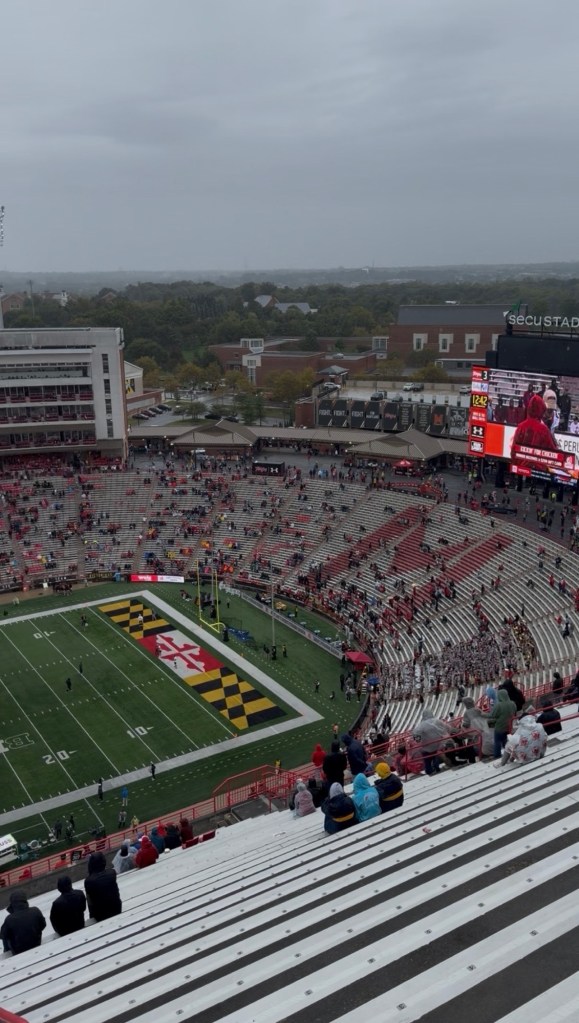
Just after halftime I took that photo, as we decided to move to seats in the 200 level that were covered from the rain by our previous section. As you can probably tell, it was not difficult to wander into any section and find a whole row to yourself. There were mostly only UCLA fans remaining, still happy cheering on their soon to be 4-0 Bruins with their shiny new head coach.
The unfortunate reality in college sports for the time being is that schools are going to have to spend more than they ever have to stay competitive. In turn, like always, this cost will predominately ruin the experience for the consumer, as they will be the ones to bear the cost. This includes students who want nothing to do with athletics, as even tuition rose five percent. Schools like Maryland will unfortunately have to conform to the norms if there is to be no governing body who will work towards reform in the pay structure in college sports. This includes transfer rules, allocation of funds, total asset disclosure, and more.
Now more than ever in this country, a dollar is to be squeezed out of every moment. College football’s intrinsic value continues to crumble under the weight of that reality. Bleachers will continue to empty out at non “blue blood” programs as ticket prices increase. Beneath the shadow cast by our nation’s capital, a microcosm of the greed of the ultra-wealthy unfolds. Does it matter enough to anyone that an American pastime as we know it is dying in the dark?


Leave a comment